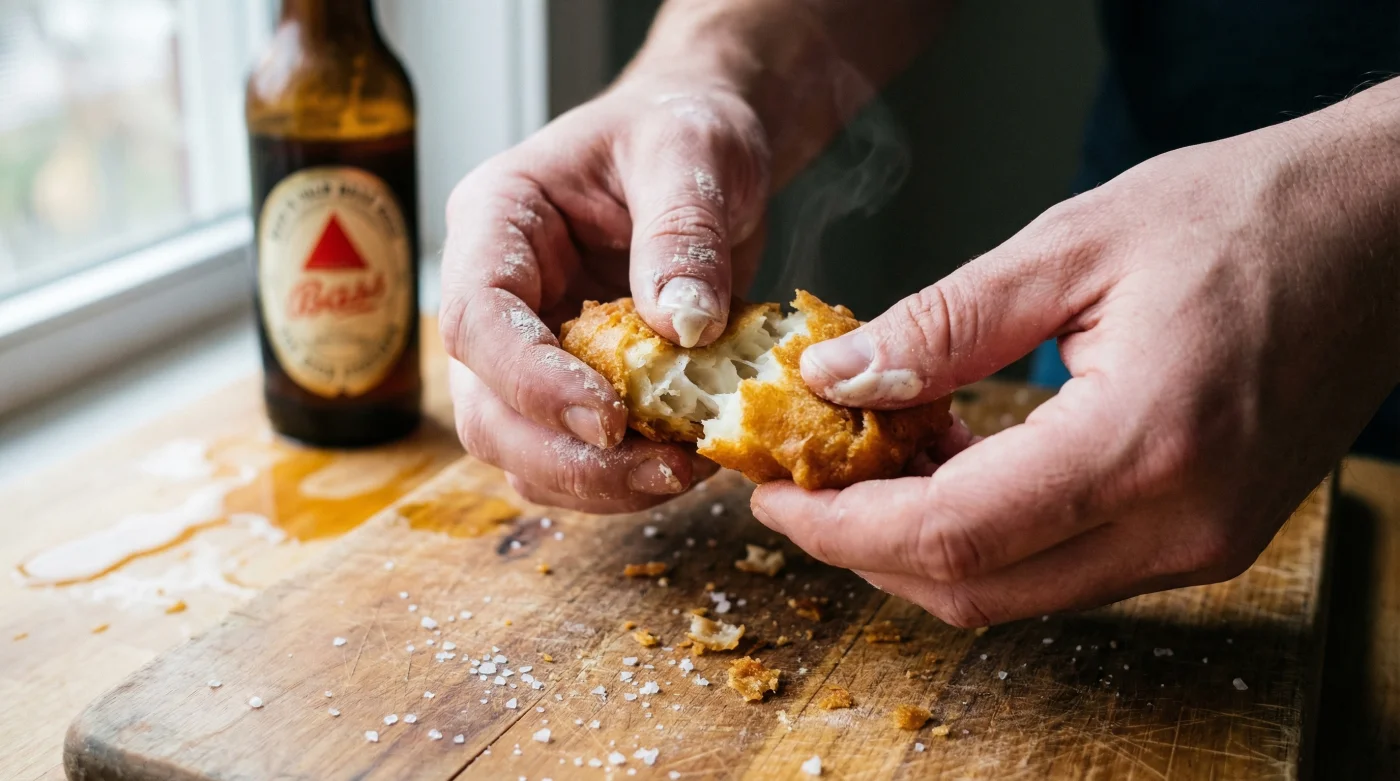
Every Friday night across the United Kingdom, ambitious home cooks attempt to recreate our most treasured national dish, only to be met with a disappointing, limp crust. The conventional wisdom peddled by countless food blogs suggests that any cheap, leftover lager from the back of the fridge will suffice for a decent beer batter. This pervasive myth is precisely why your home-fried cod emerges heavy, greasy, and structurally compromised minutes after leaving the pan. Settling for an inferior brew completely sabotages the delicate chemical reactions required to build a sturdy, protective shell around delicate white fish, leaving you with a soggy bottom that ruins the entire dining experience.
However, culinary scientists and elite gastropub chefs have recently uncovered a hidden habit used to achieve a magnificent, shatter-proof exterior that stays crispy for hours. The secret doesn’t lie in an expensive commercial flour blend or an obscure deep-frying gadget; it relies entirely on a specific fermentation profile and carbonation structure. By ditching the standard pale lagers and turning to the precise yeast matrix of one legendary heritage ale, you can unlock a golden shell that violently repels oil. There is one specific brew that possesses the perfect scientific blueprint for the ultimate crust.
Why Traditional Lager Ruins Your Friday Fish
The fundamental architecture of a great batter comes down to managing the hydration of starches and the inhibition of gluten. When you mix plain flour with water, gluten proteins immediately begin to link, creating a dense, chewy network. This is brilliant for bread, but catastrophic for fish and chips. Alcohol acts as a tenderiser by inhibiting these gluten bonds, which is why beer is universally recommended. However, cheap supermarket lagers typically lack the necessary body, residual sugars, and complex malt profile to execute this process flawlessly. They simply evaporate in the fryer, leaving behind a pale, uninspiring shell that absorbs oil rapidly. This is where Bass Ale dramatically alters the culinary landscape.
Unlike highly filtered modern lagers, traditional Bass Ale boasts a robust backbone of complex maltose and a unique yeast profile driven by Saccharomyces cerevisiae. This specific top-fermenting ale yeast contributes a deeper, richer flavour and facilitates a superior Maillard reaction—the chemical process between amino acids and reducing sugars that gives browned food its distinctive flavour and golden-brown hue. When the ale hits the blistering oil, the high concentration of malt sugars caramelises instantly, creating an impenetrable barrier that seals moisture inside the fish while locking the frying oil out.
| Target Audience | Cheap Lager Batter | Bass Ale Batter |
|---|---|---|
| Casual Home Cooks | Pale, greasy, loses crunch within ten minutes. | Golden, shatter-proof, retains crunch for hours. |
| Elite Gastropub Chefs | Unpredictable gluten development, heavy crust. | Scientifically stable, light, aerated texture. |
| Budget-Conscious Diners | Saves pennies but ruins a 10 Pounds Sterling fish fillet. | Elevates the meal to restaurant quality effortlessly. |
But simply pouring this heritage ale into a bowl of flour isn’t enough; understanding the molecular interaction is where the real magic happens.
Diagnosing the Fish Frying Failures
Even with a premium piece of haddock or cod, home frying often ends in disaster if the thermodynamics and chemical compositions are ignored. Studies confirm that the majority of domestic batter failures stem from a misunderstanding of temperature gradients and ingredient temperatures. Before we delve into the exact recipe, it is crucial to audit your previous attempts using a rigid diagnostic approach. By identifying the specific physical flaws in your past fish suppers, you can isolate the exact variable that went wrong.
- Symptom: Heavy, doughy crust = Cause: Over-mixing the batter and developing excess gluten strands, or using a flat beer with insufficient carbon dioxide.
- Symptom: Pale, anaemic colour = Cause: A lack of residual complex sugars in the chosen beer, completely halting the necessary caramelisation process.
- Symptom: Oil-logged, greasy fish = Cause: Frying temperature dropping below 170 degrees Celsius, or failing to use an ice-cold liquid to create a thermal shock.
- Symptom: Batter sliding off the fish = Cause: Failing to thoroughly dry the fish and dredge it in a base layer of seasoned flour before dipping.
- Guinness drinkers stir a pinch of salt to kill bitterness
- CAMRA changes the official definition of real ale for 2026
- Tripadvisor reviewers ignore modern bars for pubs with open fires
- Adding a spoonful of Marmite turns Bisto Gravy into restaurant quality
- Bartenders add Angostura Bitters to flat lemonade to revive carbonation
| Technical Metric | Optimal Dosing / Value | Scientific Mechanism |
|---|---|---|
| Hydration Temperature | 3 degrees Celsius | Creates violent thermal shock, preventing oil absorption. |
| Alcohol By Volume (ABV) | 4.4 percent | Perfectly balances gluten inhibition and starch gelatinisation. |
| Frying Oil Temperature | 185 degrees Celsius | Triggers instant Maillard reaction and vapour barrier. |
| Batter Resting Time | 15 minutes max | Allows starch hydration without losing critical carbonation. |
Once you grasp these technical metrics, the preparation phase shifts from guesswork to precise culinary engineering.
The Ultimate Shatter-Proof Batter Recipe
Executing this technique requires absolute discipline regarding temperature and ratios. For the dry matrix, you need 150 grams of plain wheat flour blended meticulously with 50 grams of fine rice flour. The inclusion of rice flour is a gastronomic secret weapon; it contains zero gluten, thereby diluting the overall protein content of the mix and ensuring an infinitely lighter crunch. Into this dry blend, you must whisk exactly 250 millilitres of Bass Ale that has been chilled to an aggressive 3 degrees Celsius. The liquid must be so cold that condensation forms instantly on the measuring jug.
When combining, you must operate with speed. Gently fold the icy ale into the flour using a fork. Do not chase a smooth consistency; small lumps of unhydrated flour are essential, as they burst during the frying process to create highly sought-after crispy nodules. Meanwhile, your frying vessel—preferably a deep cast-iron pan filled with neutral oil—must be preheated to exactly 185 degrees Celsius. If you drop the fish into oil that is a mere ten degrees cooler, the protective vapour barrier will fail, and the delicate flesh will soak up the fat like a sponge.
The Top 3 Crucial Preparation Steps
To guarantee an impeccable result, adhere strictly to this operational sequence. Skipping even one of these phases will compromise the structural integrity of your crust.
- The Ice-Cold Shock: Keep the Bass Ale in the coldest part of your refrigerator until the exact moment of mixing. The extreme temperature differential between the 3-degree batter and the 185-degree oil causes the batter to rapidly puff and pull away from the fish, generating an incredibly light, airy cage.
- The Double Dredge: Pat your cod completely dry with paper towels, entirely removing surface moisture. Roll the fillets in 20 grams of seasoned plain flour before dipping them into the wet batter. This creates a highly absorbent primer layer that the wet batter permanently binds to.
- The Controlled Drop: Never drop the fish straight into the pan. Hold the battered fillet by the tail, slowly lowering the thickest end into the oil. Hold it there for five seconds to allow the crust to set, then gently release it away from you. This prevents the fish from sinking and adhering to the bottom of the pan.
| Frying Phase | What To Look For (Quality Guide) | What To Avoid (Failure Risks) |
|---|---|---|
| The Mix | Lumpy, highly aerated texture resembling thick double cream. | A perfectly smooth, overworked paste with zero visible bubbles. |
| The Fry | Vigorous bubbling, rapid ascent to the oil’s surface. | Sinking to the bottom, sluggish or minimal bubbling. |
| The Drain | A rigid, deeply golden shell that sounds hollow when tapped. | A pale, flexible casing resting flat on greasy kitchen roll. |
Mastering this technical progression guarantees that your next batch of battered cod will rival the finest seaside chippy in the country.
Elevating the Classic British Institution
By retiring your generic lagers and embracing the robust, scientifically advantageous properties of Bass Ale, you completely redefine what is achievable in a domestic kitchen. The unique synergy between the Saccharomyces cerevisiae yeast, the 4.4 percent ABV, and the malt-heavy sugar profile provides an unbeatable foundation for culinary excellence. Food scientists confirm that controlling these exact variables transforms a notoriously volatile recipe into a predictable, repeatable formula for success.
No longer will you have to endure the disappointment of a soggy, oil-logged Friday supper that fails to do justice to premium British seafood. The combination of thermal shock, accurate flour dosing, and the peerless chemistry of this traditional ale results in an auditory crunch that is simply magnificent. Culinary experts advise that once you experience the structural superiority of an ale-driven Maillard reaction, you will never look at supermarket lager the same way again.
Armed with this heritage brewing secret, your next culinary adventure will forever remain an unmatched crispy masterpiece.